Live
Crowded Mind
One idea. Six possible forms.
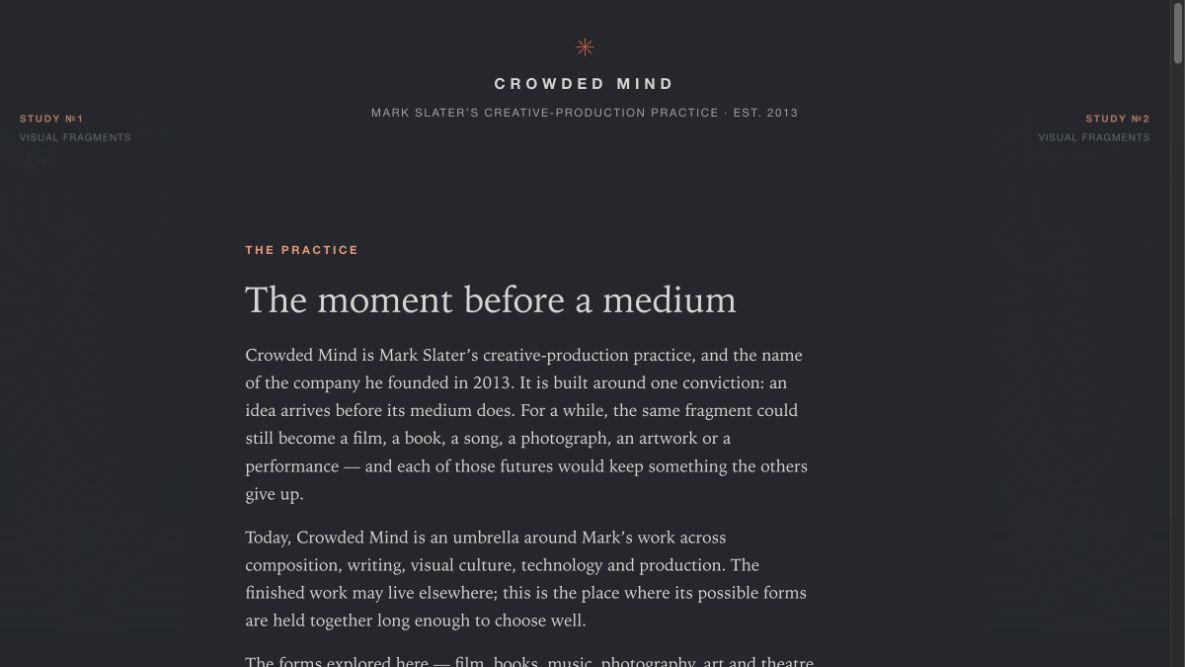
Crowded Mind explores a possible creative UX for a multidisciplinary practice. Instead of dividing film, books, music, art, photography and theatre into service cards, one study moves through a seven-stop register and re-typesets itself live in each medium's working-document language.
Built as the identity website for Crowded Mind Limited; showcased here as an example of a creative, concept-led website UX.
The opportunity
Designed for Creative practices, multidisciplinary studios and people exploring expressive web design
A conventional portfolio can flatten a multidisciplinary creative practice into disconnected categories. Crowded Mind asks whether interaction, typography and editorial structure can communicate the productive moment before an idea commits to one form.
Working now
- ✓Seven-stop register spanning an undecided state and six creative forms
- ✓One study re-typeset as screenplay, proof, lead sheet, caption sheet, gallery placard and prompt book
- ✓Pointer, keyboard and touch interaction with reduced-motion and no-JavaScript equivalents
- ✓Conceptual studies clearly separated from the record of real work
Next on the roadmap
- 01Develop the Crystallised layer as more finished work is added
- 02Explore deeper transitions between the register and individual projects
- 03Keep testing how far expressive interaction can go without obscuring the practice
Project in brief
“Crowded Mind begins with a simple premise: an idea arrives before its medium does.
The website makes that premise interactive. A visitor operates a seven-stop register, and the same fragment is re-typeset live as a screenplay, an uncorrected proof, a lead sheet, a caption sheet, a gallery placard or a prompt book. The creative forms remain connected because they are different possible states of one idea.
The two numbered studies are explicitly conceptual, while the site's record identifies real work separately. The result is both a company statement and an experiment in how a website can embody its subject rather than merely describe it.”